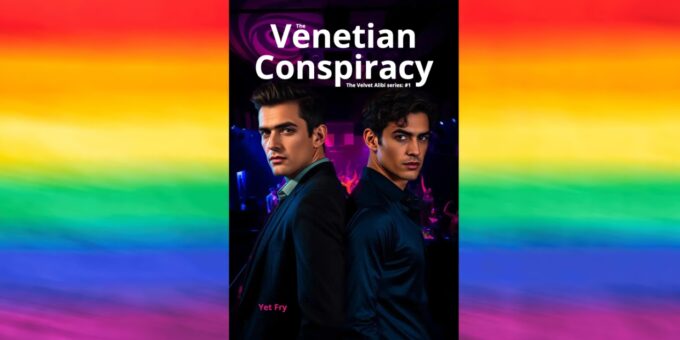
The Venetian Conspiracy Is the LGBTQ Thriller You’ve Been Waiting For
What happens when the institutions designed to protect your community are quietly, methodically turned against it? Not through open hostility—but through the far more insidious machinery of philanthropy, psychiatry, and law enforcement working in concert to erase the people who know too much?
That question sits at the beating heart of The Venetian Conspiracy by Yet Fry, and for LGBTQ readers who have ever felt the cold dissonance of watching a system smile at you while sharpening its blade, this book will feel less like fiction and more like a mirror.
The Fear That Never Fully Goes Away
There is a particular kind of exhaustion that comes from living in a world where the danger doesn’t always announce itself. It doesn’t always arrive with slurs or violence. Sometimes it arrives in the form of a respected doctor, a well-connected civic figure, a charity gala with rainbow branding, and a hidden ledger. Sometimes the threat wears the face of an ally.
For LGBTQ individuals and communities, the fear that the systems meant to protect them can be weaponized against them is not paranoia—it is pattern recognition. It is the knowledge that LGBTQ-owned spaces are vulnerable not just to street-level hostility but to targeted institutional destruction. It is the awareness that witnesses can be erased not with violence but with a psychiatric diagnosis, that truth can be reframed as delusion by anyone with enough credentials and enough to hide. And it is the deeply personal terror of watching someone you love walk into danger you cannot stop, while the people who should be helping look the other way.
This is the emotional landscape that The Venetian Conspiracy inhabits—and it does so with unflinching intelligence and narrative precision.
A Thriller That Understands What’s Actually at Stake
The Venetian Conspiracy by Yet Fry is the explosive debut entry in the Velvet Alibi series, and it arrives as one of the most sharply realized LGBTQ crime thrillers in recent memory. When a young promoter dies on the dance floor of The Velvet Alibi—Manhattan’s most celebrated gay nightclub—the NYPD calls it an accident. Kai Adler and Ethan Klein, the married owners of the club, know better. What begins as a murder investigation rapidly unravels into something far more dangerous: a conspiracy that implicates a rival club owner, a street gang, corrupt law enforcement, and a respected psychiatrist named Dr. Finch who runs illegal operations behind a philanthropic mask—including covert funding of conversion therapy groups hidden beneath layers of charitable respectability.
What distinguishes this novel from other entries in the LGBTQ crime fiction space is its refusal to treat the community’s vulnerability as a backdrop. The Velvet Alibi is not just a setting—it is a sanctuary, a piece of living history, a space built on the understanding that LGBTQ people deserve somewhere the world cannot reach them. When that space is threatened, the stakes are not merely commercial. They are existential. Fry understands that the commodification and exploitation of LGBTQ history for profit or cover is one of the most corrosive forces a community can face, and the novel weaponizes that understanding into plot.
At the center of the story is a partnership that is itself a study in complementary strengths under pressure. Kai—a former fighter with a dangerous instinct for justice—operates on instinct, urgency, and physical courage. Ethan—the strategist, the pattern-reader, the man who sees three moves ahead—operates on analysis and restraint. Their friction is constant and entirely believable. Their alignment, when it finally comes, is formidable. But the novel’s most compelling transformation belongs to Ethan: when the plan collapses, and Kai cannot act, Ethan must step out of his defined role as the brain of the operation and go alone into danger. It is a transformation from planner to executor that redefines him—and it is earned on every page that precedes it.
What This Book Illuminates
One of the most powerful insights The Venetian Conspiracy offers is its portrait of gaslighting as a weapon of institutional control. Dr. Finch does not simply threaten or intimidate—he systematically reframes truth as delusion, resistance as pathology, and love as codependency. His method is to make victims doubt their own perceptions, to render facts useless as tools of liberation. A handwritten note scrawled in the margins of a psychiatric intake form—“He’s not crazy. He saw the books. He knows about the money going to the conversion therapy groups in Jersey. Finch is cleaning house. Help me.”—captures the horror of this mechanism with devastating economy. When the villain controls the doctors, the judges, and the narrative, evidence alone is never enough. What Kai and Ethan must overcome is not just a conspiracy but the architecture of credibility that protects it.
The novel is equally unflinching about the moral cost of dangerous alliances. Survival, Fry argues, sometimes requires allying with morally compromised figures—and the partnership with a character named Crowe illustrates this with uncomfortable clarity. The book does not let its protagonists off the hook for the choices they make under duress. It asks, with genuine seriousness, whether the ends can justify the means—and it refuses to answer cheaply. This is a thriller that respects its readers enough to sit with moral complexity rather than resolve it with a convenient twist.
And beneath the conspiracy, beneath the danger and the deception, there is a love story that refuses to be decorative. “I love you. More than the club, more than this city, more than my own fucking pride. You remember that,” Kai whispers to Ethan before a mission that may cost them everything. “We’re not expendable to each other”—not a declaration, but a statement of fact, more powerful for its simplicity. In a genre that too often treats LGBTQ relationships as either tragedy or tokenism, The Venetian Conspiracy positions love as an anchor—not a weakness to be exploited, but the very thing that makes courage possible.
The Story Your Community Deserves to See Told
There is a line near the end of the novel that lands like a fist: “We are not a problem to be fixed. We are the solution. We are the alibi. We are proof that life, in all its messy, beautiful, chaotic glory, is worth living.” Ethan speaks these words at the reopening of The Velvet Alibi, in the aftermath of everything—the murders, the conspiracy, the near-destruction of the space they built together. It is a moment of reclamation that feels genuinely earned, because the novel has not shielded its characters from the cost of the fight. It has let them bleed, doubt, deceive each other, and nearly break—and then it has let them choose, again, to stand.
This is what separates The Venetian Conspiracy from thrillers that simply feature LGBTQ characters. It is a novel about what it means to build something in a world that would prefer you didn’t, to fight for a community whose history is constantly at risk of erasure, and to love someone when that love makes you more visible—and therefore more vulnerable—to the forces that want you silent.
If you are looking for an LGBTQ crime thriller that takes identity and survival seriously, that explores corrupt power structures without reducing them to caricature, and that delivers genuine emotional stakes alongside its plot mechanics, The Venetian Conspiracy is exactly the book you have been waiting for.
Ready to discover what Kai and Ethan uncover in the shadows beneath Manhattan’s nightlife? Get your copy at AMAZON and begin the series that refuses to look away.
#LGBTQCrimeFiction #ThrillerReads #LGBTQBooks #CrimeFiction #LGBTQThriller #TheVenetianConspiracy #VelvetAlibi #LGBTQAuthors #DarkConspiracy #QueerFiction